
Read time: 8 minutes
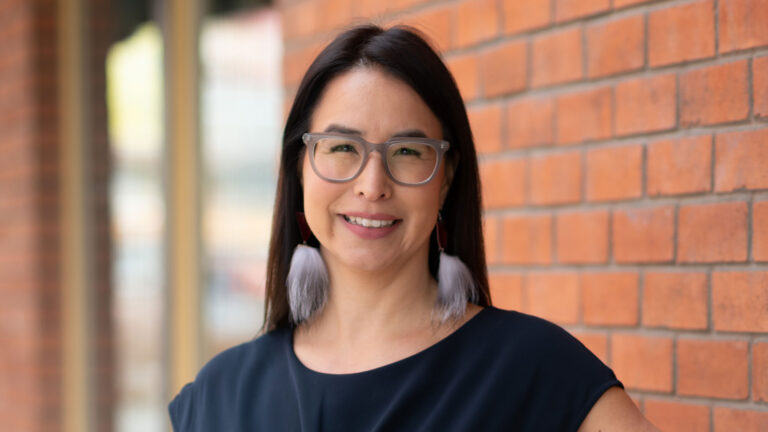
It only takes a few moments speaking with Amber Ruben to realize she is the right person, in the right place, at the right time.
Soft spoken but impossible to ignore, in a few words she can effortlessly drill down to the heart of the complex issue she tackles every day and make you believe that change is needed, is possible, and is happening. Yet no one is more surprised than her that she is where she is today, a key thought leader in Indigenous health and reconciliation in Alberta.
“Early on, I was getting settled into my career and getting a sense of where I fit within my own profession, within the hospital, within the teams,” said Amber. “I didn’t think about advocacy within the Indigenous health realm in and of itself; it was on an individual level having discussions with folks when something would come up that didn’t feel comfortable.”
Her path from young hospital pharmacist to her current role as a consultant on Indigenous health equity and reconciliation with Covenant Health has taken many turns, including nearly going down a road that wasn’t pharmacy at all. Amber originally came to Alberta to study and attain a bachelor’s degree in neuroscience with the aim of going into research, but craved a more patient-centric environment. She completed her first degree, then moved to the University of Alberta (U of A) to study pharmacy, inspired by an example from her childhood in Fort Smith, Northwest Territories.
Working in a local pharmacy as a teenager, she had seen how the pharmacist’s interactions with patients could have an amazing impact.
“She was one of the few healthcare professionals who was a constant within the community, because we didn’t always have that with physicians,” said Amber. “People really relied on her for her knowledge, her continuity of care, for her ability to recommend over-the-counter medications, and she really became an integral part of the healthcare system within the community.”
Those relationships with patients were even more key when serving the large local Indigenous population in Fort Smith. As an Inuvialuk (Inuit from the northwestern Canadian Arctic region), Amber knew how many different Indigenous cultures prioritize relationships when building trust.
“Relationships are that key factor within an Indigenous worldview, and I say that in a very pan-Indigenous way, relationships are really fundamental,” said Amber. “We usually introduce ourselves according to our family names, our kin, and the lands we’re connected to, and if you think about pharmacists, again, part of that key is establishing relationships with patients.”
She also knew only too well how the colonial history of Canada has damaged Indigenous patients’ trust in the government and the health system in general. Amber’s father, Nanuk (grandmother), and many other family members were all survivors of the residential school system.
Fast forward to her entry into practice as a hospital pharmacist in Alberta, and she began to see the issues that needed to be addressed.
“I would hear comments that were derogatory or stereotypical against Indigenous patients, and that made me realize how much education was needed and how prominent stereotypes were and continue to be,” said Amber.
Integrating Indigenous perspectives and anti-racism in pharmacy education
Read more ➞
She started working on some small initiatives at Covenant Health for specific programs like National Indigenous History Month, then later accepted an invitation to start speaking with U of A Faculty of Pharmacy and Pharmaceutical Science students about Indigenous health issues.
“Once you start something I feel like it snowballs, and that’s exactly what happened here,” said Amber. “I started with those few lectures and almost immediately I thought I could do a master’s degree because there’s so much we still need to know. And from the master’s more doors opened up, including my own need to further this work.”
That passion for advocacy has certainly led to more work—a lot more work that she is proud to contribute to. She was encouraged to join Covenant Health’s Indigenous Advisory Body when it was formed and now serves as co-chair, and she sits on the board of the Indigenous Pharmacy Professionals of Canada (IPPC). She has worked with both the IPPC and the Association of Faculties of Pharmacy of Canada to develop equity, diversity, and inclusion resources, worked with the Canadian Medication Appropriateness and Deprescribing Network on decolonizing and Indigenizing, and eventually took on a consulting role for Covenant Health working on Indigenous health equity and reconciliation.
Empowering Canada’s Indigenous pharmacy professionals
Read more ➞
“I think it’s absolutely necessary to fund positions that are solely responsible for this type of work, for it to take root, for it to promote, for it to spread,” said Amber. “As a voluntary group, the Indigenous Advisory Body certainly made strides in bringing this work forward, but now there is dedicated time to educate staff, complete policy-work, create strategy, and participate in Indigenous recruitment through a focused position.”
And remember that master’s degree mentioned earlier? In addition to all her other contributions, Amber is in the final stages of a research project that she hopes will help community pharmacies and Indigenous patients across Alberta. Having seen in her youth how those pharmacies could serve as a key pillar of local health care, she wanted to examine how Indigenous patients viewed their interactions with pharmacists.
“Community pharmacists can have such a value within communities, especially when I think back to the community pharmacist in my hometown,” she said. “They can be such an accessible source of health information and disease management.”
Seeking a research partner, Amber found one in the Alexander Research Committee in Alexander First Nation. Speaking with patients there over time, she explored the barriers they had encountered, including racism, discrimination, and stereotyping. The conversations revealed that many of the healthcare workers these patients encountered had a concerning lack of knowledge about First Nations’ worldviews (particularly the Cree worldview, in this case), the cultural importance of Elders and traditional medicines, and the historical context at play.
“A lot of people don’t know enough about the colonial history of Canada. None of us were provided that education, including me,” said Amber. “For example, we have all been taught in social studies that First Nations gave up their land, and that’s not the case. We weren’t informed about the creation of the reserves, the Indian Act, the Sixties Scoop, Indian hospitals, or the atrocities that occurred in residential schools. These colonial systems whose intent was to assimilate created the health inequities we see today.”
That lack of context can negatively influence a relationship with an Indigenous patient. A simple misunderstanding of treaty rights can lead to frustration when dealing with common issues, like First Nations health benefits.
“I know that non-insured health benefits can be frustrating, but as soon as that frustration is expressed in front of a patient, that’s creating a negative experience for somebody,” said Amber.
Amber also found ways that pharmacists can build and facilitate relationship building. As she prepares her findings, Amber hopes to eventually bring the lessons she has learned to pharmacy professionals across the province, enabling them to provide person-centred care to Indigenous patients.
“There are really small ways to change behaviours. Even if you’re not going to embark upon an hour-long discussion, try and spend a minute or two with each interaction to try and build on that relationship and build that trust,” said Amber.
She hopes more pharmacy professionals will look for education and opportunities to incorporate small gestures that can have a large impact.
“Take cultural safety training or trauma-informed care training. Try to create and maintain signs of being a safe space, whether that is displaying local Indigenous art, whether it is showing a First Nations specific medicine wheel highlighting the colours that the Nation closest to you uses,” she said. “Or have a conversation with someone from a Nation or Métis community close to you about what would be an appropriate welcoming sign in your pharmacy.”
Meanwhile, Amber is continuing her own advocacy journey, hoping to share education and information in ways that provide value to healthcare professionals across the province.
“It’s not asking anybody to throw away their whole practice or the way they practise, but to just start with small steps,” says Amber. “As pharmacy professionals, our standards, ethics, and person-centered care model support change for Indigenous patients. We just need to lead this work with our hearts.”