

Background
As regulated members, you are expected to practise in a manner that is evidence‑informed and consistent with the Alberta College of Pharmacy’s (ACP) standards of practice and Code of Ethics. Evidence‑informed practice incorporates the use of
- evidence‑based information;
- your own professional knowledge and clinical judgment; and
- the individual patient’s values, preferences, and circumstances.
Evidence‑based information is derived from credible and reliable sources that are applicable to the specific problem or situation being considered. This information is meant to inform your professional judgment, not replace it. You must consider the quality, relevance, and applicability of information when making decisions for individual patients.
Evidence‑based information may be limited, evolving, or not directly applicable in all situations. Evidence‑informed practice therefore requires the use of appropriate judgement and proper consideration of patient preferences and values to support decision making. This document provides guidance that supports regulated members in applying evidence‑informed practice in a manner consistent with your professional and regulatory expectations.
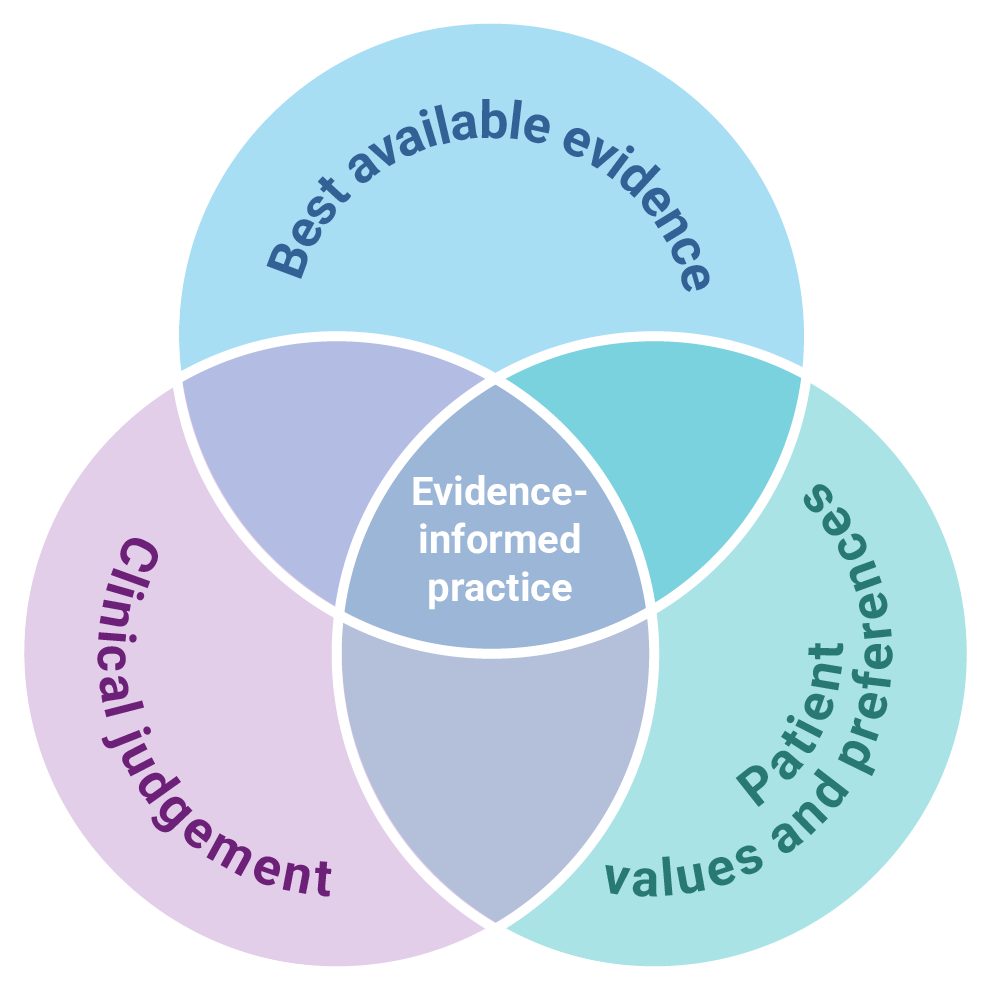
The evidence-informed process (see Figure 1) integrates three key components:
- Best available evidence
- Clinical judgement
- Patient values and preferences
This approach ensures that decisions are person‑centred, transparent, and grounded in the most reliable information available.
Figure 1: Evidence-informed practice.1
Advice
The evidence-informed practice process
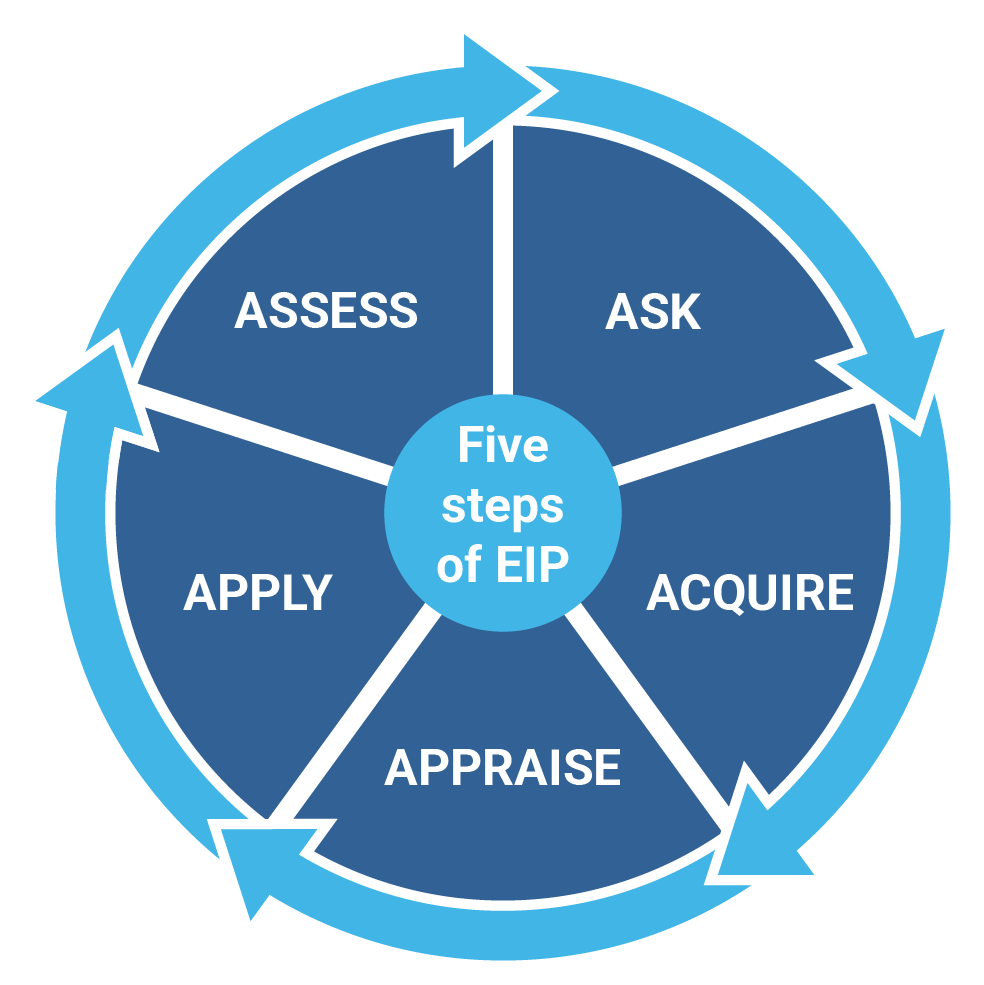
The 5 A’s of evidence-informed practice (see Figure 3) provide a structured approach to decision-making when providing patient care. The 5 A’s are
- ASK the question,
- ACQUIRE the evidence,
- APPRAISE the evidence,
- APPLY the evidence, and
- ASSESS the outcomes.
This process supports you in systematically identifying, evaluating, and using evidence‑based information along with your professional judgment and the patient’s specific circumstances. Applying this process helps to ensure your decisions are reasonable and person‑centred.
Figure 2: Five steps of EIP.2
1. ASK the question – Clearly define the practice question and identify a search strategy
- Collect information about the patient to assist research. Using patient-specific information ensures that selected resources align with your patient’s needs. Review your patient’s symptoms, medical history, current therapies, clinical records (including Netcare), laboratory results, and pharmacy patient record.
- Clearly define the clinical question to find appropriate sources of evidence. Whether you are addressing a patient concern, supporting a prescribing decision, verifying drug information, or preparing for interprofessional communication, defining the reason for your search establishes priorities and ensures that the information you gather is relevant.
- Structure your practice question using a tool such as PICO (Population, Intervention, Comparison, Outcome). This breaks the question into searchable elements. PICO can help highlight what is known, what remains uncertain, and what requires clarification, which will help you target the most appropriate resources and evidence.
2. ACQUIRE the evidence – Find the best available evidence
- Seek the best available evidence. To support efficient searching and reliable findings, begin with evidence at the top of the EIP pyramid (see Figure 3). By beginning at the top, you rely on evidence that has already been evaluated and synthesized.
Figure 3: Evidence-based information pyramid.3
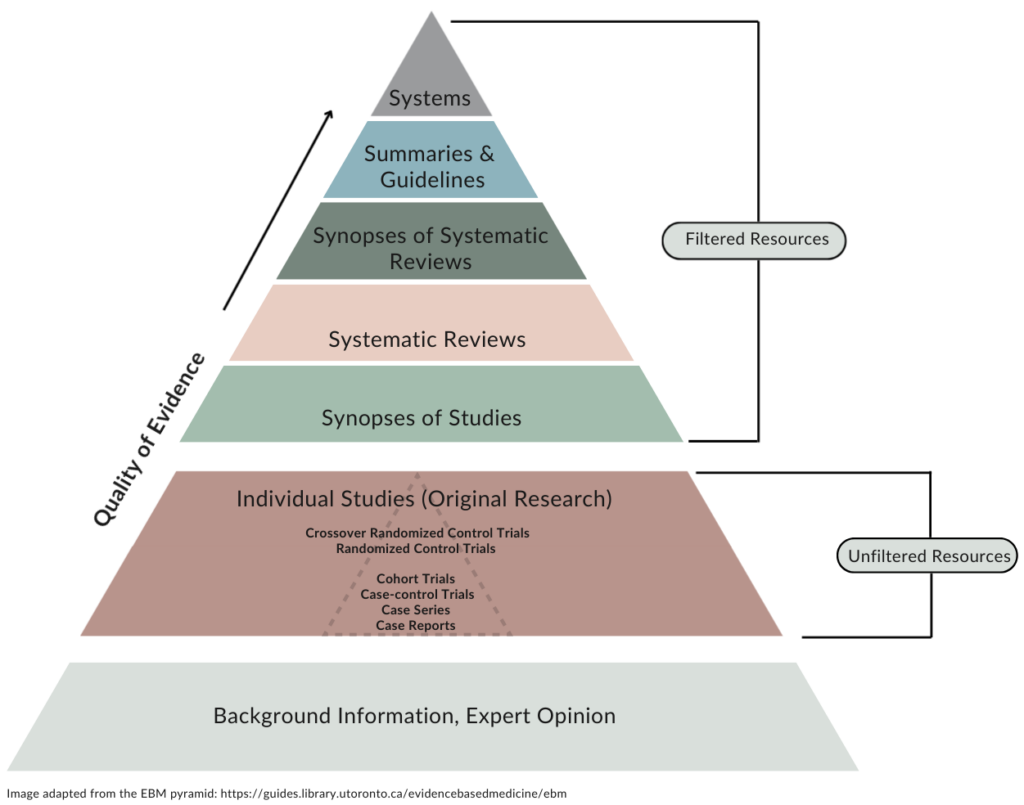
- Match the depth of your search for evidence to the complexity of the situation and the time you have. While time constraints may require a more focused approach, it remains essential to rely on the highest-quality evidence you can access by prioritizing sources such as summaries and guidelines. For more complex or unclear practice questions, you may need to explore systematic reviews or individual studies. The goal is to identify the highest quality evidence possible within the context of the situation.
3. APPRAISE the evidence – Evaluate the quality, credibility, and relevance of the evidence.
- Assess study design and methodology. Evaluate study design, sample size, methodology, outcome measures, and potential sources of bias. Consider how participants were selected, whether randomization or blinding was used, and whether the results were reported transparently. Appraising the methodology used supports informed and appropriate use of evidence‑based information in practice. The Centre for Evidence Based Medicine has developed this resource to assist health professionals.
- Recognize when evidence is insufficient or uncertain. Not all practice questions will have answers that can be supported by strong or conclusive evidence. Recognize when evidence is outdated, inconsistent, based on small or unrepresentative samples, or unclear about its methods. When this occurs, the limitations of the evidence should be considered in your decision-making process.
- Determine the applicability of the selected evidence to your patient or clinical scenario, then integrate it into your decision-making. Assess how closely the patient population, intervention, and outcomes are described in the evidence align with your patient or clinical scenario. Even high-quality evidence is less valuable if it does not fit your patient’s age, condition, comorbidities, or health goals.
4. APPLY the evidence – Use evidence-informed practice to guide patient care decisions.
- Once you have evaluated the evidence, combine it with your knowledge of the patient, your expertise, and your professional judgment. This process requires considering the strengths and limitations of the evidence and determining its implications for the patient’s care plan. Integrating these elements ensures you make balanced, evidence-based, and person-centred decisions.
- Explain the evidence in an easily understandable and person-centred way. Patients may find clinical terminology or statistical concepts difficult to understand. Avoid jargon and explain key points in a way that reflects the patient’s health literacy, preferences, and concerns. Communicate evidence in clear, plain language that emphasizes the relevance of the information to the patient’s health and decision-making. Linking evidence directly to your patient’s condition, medications, goals, and experience helps the patient understand why you are making the recommendations you are. This supports informed consent and helps the patient participate meaningfully in decisions about their care.
- Collaborate with other healthcare providers when needed. Some decisions are complex and may need input from other healthcare professionals in the patient’s circle of care. Effective communication ensures alignment, reduces the risk of providing conflicting information, and supports team-based care.
- Incorporate the patient’s perspectives and engage in shared decision-making. Shared decision-making recognizes that patients contribute their values, preferences, and lived experiences to health decisions. Invite questions, address concerns, and encourage active patient participation in choosing appropriate options, ensuring that their input is an essential part of the decision-making process.
- Document all key elements of the evidence-informed decision-making process in accordance with Standard 7.10 and Appendix E of the SPPPT. Accurate documentation creates a clear record of the evidence you reviewed, your rationale for decisions, and the plan for care established through discussion with the patient. This supports continuity of care and meets professional standards for accurate record-keeping. Complete documentation promptly, using a legible and permanent format. Make any amendments in a way that preserves the original entry and identifies the individual responsible for the change.
5. ASSESS the outcomes – Review and reflect
- Reflect on patient outcomes. Evaluate whether the intervention achieved the desired therapeutic and person-centred outcomes, including symptom improvement, safety, adherence, and the patient’s satisfaction with the result. Consider both clinical measures and the patient’s own experience to determine whether their goals were achieved.
- Identify knowledge gaps and opportunities for professional development. Regular reflection on decisions you have made and the resulting patient outcomes can guide you in identifying areas for professional growth. This may include determining what additional knowledge is needed and how you might improve your communication skills.
Summary
Evidence‑informed practice supports pharmacists in delivering safe, effective, and person‑centred care in increasingly complex practice environments. By systematically identifying and evaluating evidence‑based information, applying professional judgment, and incorporating patient values and preferences, you can make decisions that are clinically sound and person-centred.
Clear communication and shared decision-making further ensure that patients understand their options and remain active partners in their treatment decisions. Together, these activities support evidence-informed practice, align with the standards of practice, and contribute to improved patient outcomes across all areas of pharmacy care.
Further reading
- University of Toronto Libraries. Evidence-Based Practice: What is Evidence-Based Medicine (EBM) or Evidence-Based Practice (EBP)? November 2024.
- University of Toronto Libraries. Evidence-Based Practice: Classic Question Formulas. November 2024.
- Centre for Evidence-Based Medicine. Making a decision.
- UC Davis Library. Evidence-Based Practice Resources.
- Adapted with permission from UCPE 03D – Evidence-based Resources for Pharmacy Professionals. Alesha Bloor and Trudy Huyghebaert. University of Saskatchewan. ↩︎
- Adapted with permission from UCPE 03D – Evidence-based Resources for Pharmacy Professionals. Alesha Bloor and Trudy Huyghebaert. University of Saskatchewan. ↩︎
- Used with permission from UCPE 03D – Evidence-based Resources for Pharmacy Professionals. Alesha Bloor and Trudy Huyghebaert. University of Saskatchewan. ↩︎