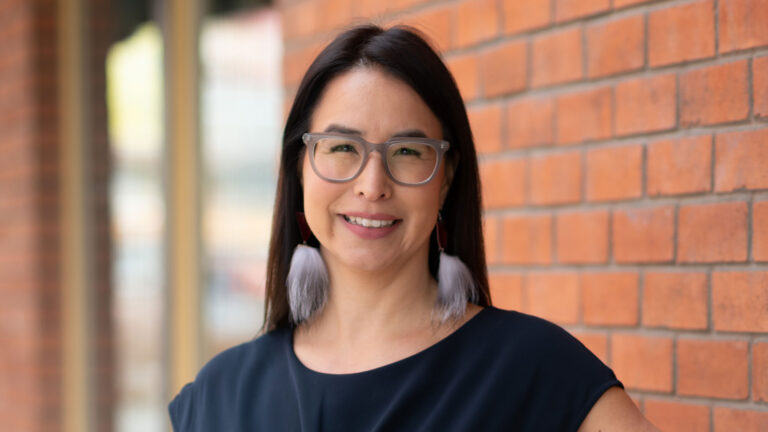

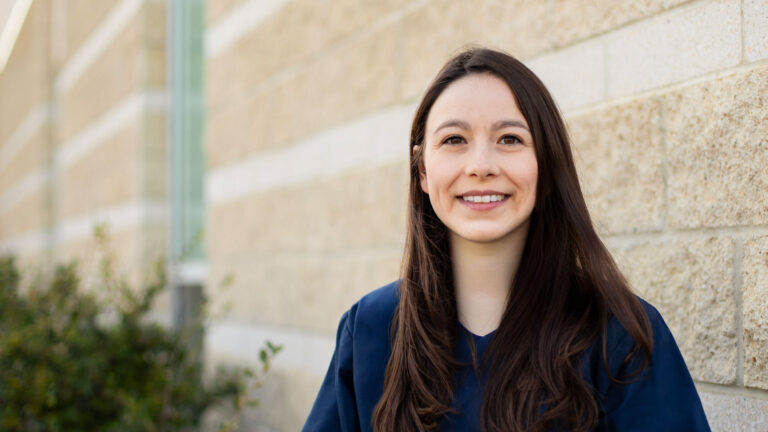
When we first met High Level’s Katerina Wolfe, she had just graduated from the pharmacy technician program at NorQuest College and had begun her professional journey as a provisional pharmacy technician in nearby Fort Vermilion. That was 2018.
Now, Katerina—a member of the Tallcree First Nation—has seven years of experience as a pharmacy technician. By 2019, the 45-minute commute to work became too much, so she asked to be transferred to a sister community pharmacy in High Level. In 2023, she had a baby and had planned on returning to the community pharmacy when her parental leave finished. That’s when another opportunity came knocking.
“There had been a lot of turnover at the hospital in High Level (Northwest Health Centre), and somehow my name got floated around,” said Katerina. “The hospital reached out to me and asked me to come for an interview because they needed a tech. I thought long and hard about it. Do I stay in community? Do I stay with my employers that I really enjoy? I ended up deciding to take the hospital position because I thought it would work better for the hours now that I’m a mom.”
Leaving community pharmacy was a tough decision for Katerina. One of the benefits of working in community as a pharmacy technician, she said, is working directly with patients. She does less of that now in hospital but still enjoys new challenges.
“I like the hospital in that it’s a different pace,” she said. “I have a little bit more time to think compared to my role in community pharmacy. I love what I do now, but I do miss the hustle and bustle with the patients.”
When Katerina graduated from NorQuest after two years living in Edmonton, she didn’t hesitate to return to her home community to practise. Seven years later, she knows she made the right decision.
“Oh yes, 100 per cent,” said Katerina. “I don’t know what happened, but when I went on mat leave, a lot of the pharmacy technicians in High Level just moved away. When I was ready to return to work, I was needed at the community pharmacy and I was needed at the hospital. I had to pick which one was best for me. I like being needed and I like being able to contribute to my community.”
Working in her role in hospital, Katerina is sometimes able to draw from her experience in the community to help patients—not only from a pharmacy perspective, but also as a community member.
“Once when I was still new at the hospital, a nurse came to me needing an EpiPen for a two-year-old child. I said, ‘Absolutely, I’ll get you an EpiPen. We’ll give it to you, and you can send the family on their way.’ When I went back to the pharmacy, I was told that EpiPens aren’t formulary in the hospital, so you can’t just give it out. We didn’t even stock it. Meanwhile, this family was getting discharged and this two year old had a severe allergy.”
Complicating matters more, the child didn’t have treaty status yet, and the family couldn’t afford an EpiPen on their own. Katerina referred the family to her former community pharmacy, told them to explain their situation to the pharmacist, and explained that the pharmacist may be able to write a prescription for them. She also said the pharmacist may be able to figure out a way to get the cost of the EpiPen covered for them.
“The family was able to get the EpiPen which was really great,” said Katerina. “The pharmacist arranged to have an EpiPen delivered to the family the next day. I thought it was kind of cool that I was able to facilitate that and help them get their EpiPen.”
When Katerina graduated, she had hoped to be a role model for other First Nations community members in northern Alberta to pursue a career as a pharmacy technician—or any health professional for that matter. She says it’s been a challenge.
“I have tried,” she said. “I always talk highly about being a pharmacy technician, especially if there’s a pharmacy assistant who shows promise. I’m always telling them, ‘Go for technician!’ But we’re just so remote that it’s just not an option for them to move to Edmonton for two years to take the program. If we had resources closer, I’m sure we would see a rise in First Nations individuals working in pharmacy. I would love to see that.”
In the meantime, Katerina is looking to continue getting stronger in her role as a hospital pharmacy technician and perhaps help the community pharmacy when needed. Katerina says that working in a rural setting like High Level is rewarding, and she encourages up-and-coming pharmacy technicians to consider a career outside of the big cities.
“If you want to skip the hustle and bustle of the city and still work in a place that you find interesting, I feel like new techs would really excel in rural places,” she said. “It is fast paced, but you have more of a chance to get to know patients and build a rapport with them. When you get to know people, you’re closer to your profession because you’re closer to the patient.”