
A mail order licence is required to deliver medications if the patient does not regularly receive in-person care.
Community pharmacies may choose to deliver medications to patients for convenience and accessibility. Regulated members regularly reach out to ACP to ask when a mail order licence is required as there is a perception that this licence category is needed when medications are delivered to patients. When pharmacies offer prescription delivery services, they must remember that it is not the act of delivery that matters, but whether the patient regularly receives in-person care. This consideration will determine if the pharmacy requires a mail order licence.
As described in the Standards of Practice for Virtual Care (SPVC), there are limited instances where patients will not routinely attend at the pharmacy for care. When these populations are served by the pharmacy, a mail order pharmacy licence is required.
The SPVC reflect the understanding that the ability of regulated members to routinely engage with patients or their agents in person is fundamental to the practice of pharmacy. Where in-person care is impossible or impractical, virtual care may be able to meet the needs of patients in remote or underserviced locations, as well as patients who are otherwise unable to obtain timely in-person care. These are the instances where a mail order pharmacy licence must be in place.
Considerations for delivery of medications for in-person care versus virtual care
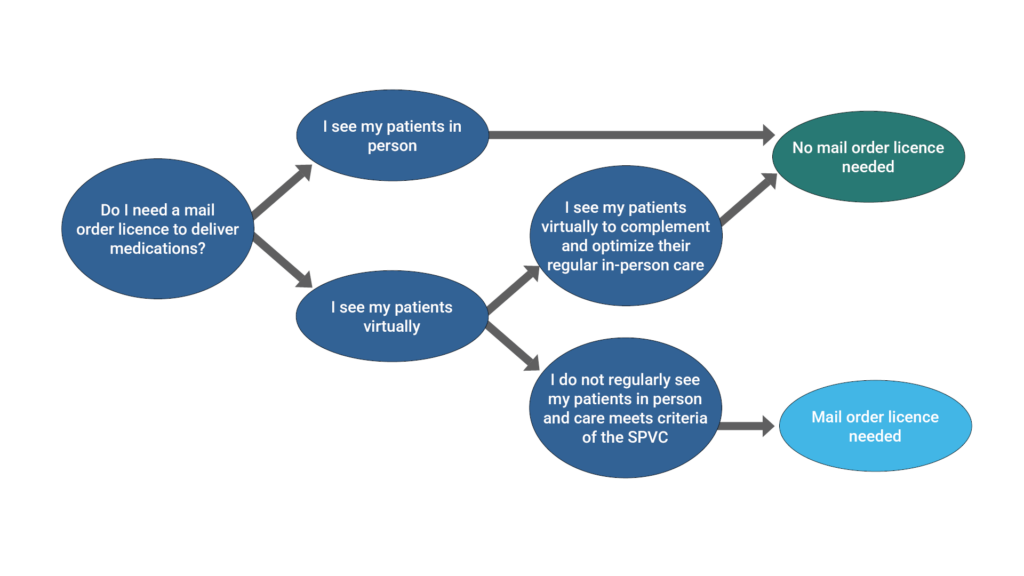
If patients regularly meet with the pharmacy team in person for assessments and to receive care, the pharmacy team may choose to deliver prescriptions and a mail order licence is not required.
If a regulated member provides restricted activities using virtual care to optimize or complement a patient’s regular in-person care, the pharmacy team may choose to deliver prescriptions, and this would also not require a mail order licence.
If a regulated member provides restricted activities using virtual care, as defined in the SPVC, to patients they do not see regularly in person, the pharmacy must have a mail order pharmacy licence.
Examples
The mode of delivery does not impact licensing requirements—it does not matter how the medication is physically delivered to the patient. Whether medications are delivered by Canada Post, courier, or pharmacy staff, if the patient does not receive regular in-person care, in accordance with the SPVC, from the pharmacist either at the pharmacy or at another location, a mail order licence is required.
An in-person assessment does not need to be conducted at the pharmacy. For example, if a pharmacist visits a retirement complex to complete in-person assessments and delivers prescriptions based on those in-person assessments, the pharmacy would not require a mail order licence. In general, if a pharmacist assesses the patient in person, the pharmacy does not require a mail order pharmacy licence.
Ultimately, as illustrated in the figure below, when determining if a mail order licence is required, you need to consider how care is being delivered – virtually or in-person – rather than how medications are delivered. If care is provided virtually, assess your situation against the criteria described in the SPVC. Where patients are not regularly seen in person and care is primarily virtual, a mail order pharmacy licence is required. Where practices do not meet the SPVC expectations, services must be revised to ensure compliance, regardless of licensing.