


Read time: 7 minutes
Pharmacist-led clinics are becoming a more popular way for pharmacy teams to provide health care to Albertans. In 2025, ACP received 123 pharmacy renovation applications, many of which were due to pharmacies adding more private consultation spaces to provide direct patient care as part of a pharmacist-led clinic.
We visited with two licensees to learn more about the services their pharmacist-led clinics provide and the difference this model of patient care is making for their communities.
Aaron Lyons, Lakeside Pharmacy, Lloydminster
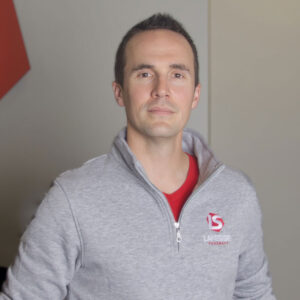
Aaron Lyons grew up in Lloydminster. After graduating from high school, he worked as an unregulated employee at a local pharmacy and found his passion. When he finished pharmacy school at the University of Saskatchewan, Aaron returned to Lloydminster to practise as a pharmacist. He’s been there ever since.
“What I liked about the profession at first was that you could sit down with patients and help them with almost anything related to their health,” said Aaron. “Still, it wasn’t until my fourth year when I really understood why pharmacists are so important. That was when I was able to really develop professional relationships with patients. It’s that connection that allows patients to build the trust with both the healthcare system and with individual healthcare providers and I see that almost every day.”
After 15 years of practice, Aaron moved to Lakeside Pharmacy, which started the “Health Hub” concept shortly after his arrival.
“The pharmacist-led clinic gives patients a better understanding of what we do as pharmacists,” said Aaron. “They may have had no idea that we could sit down and talk. The one-on-one care that pharmacists can provide is amazing, and we do it every day. We do it in the dispensary, but in this pharmacist-led clinic, we amplify how a pharmacist’s care can be completed. The clinic itself gives the patient their own time, their own space. It makes the interaction so much more in-depth and personable, and it allows for streamlined communication and service.”
Aaron said that in communities like Lloydminster, pharmacist-led clinics fill a significant healthcare gap. Lloydminster, which sits right on the border between Alberta and Saskatchewan, has 30,000 residents. Within a 150-kilometre radius, that number increases to 200,000 people who access Lloydminster for health services.
“Lloydminster doesn’t have the capacity to manage that type of demand, so a pharmacist-led clinic gives another option for services that are needed and should be available,” said Aaron. “What we’re trying to do is alleviate some of the burden on the healthcare system. We want to make sure people can get the care that they need at the time they need it. We see a lot of patients with acute conditions who are unable to see their family doctor for two or three months. We see ourselves as being almost the mediator or the interim appointment, or we help them navigate some of those issues and let them know that there are a lot of things we as pharmacists can help with. When we can’t help ourselves, the next step is then advocating and communicating, reaching out to the physicians or to their healthcare team to see how we can get this patient the timely care they need.”
Aaron believes the services his team provides patients has benefitted the greater Lloydminster community. Feedback from patients has been positive. Aaron has this advice for pharmacy teams who are considering moving to a pharmacist-led clinic model:
“It’s worth it. It can seem daunting, complicated, and a little scary, but we’re doing very similar acts we already did in the dispensary with the clinic. It gives that patient the comfortable aspect of a one-on-one assessment. It also allows you as a pharmacist to build your scope and to broaden your ability when it comes to prescribing and providing person-centred care to patients.”
Reid McDonald, Sunset Ridge Pharmacy, Cochrane
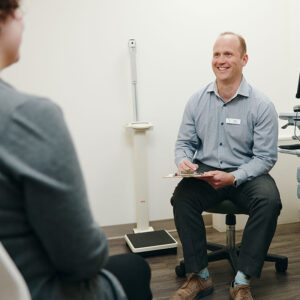
Reid McDonald and his wife, Anita, entered the pharmacist profession in 2013, shortly after the scope of practice for pharmacists expanded to include prescribing and administering injections. As students, they worked in environments where pharmacists were struggling to embrace the new scope and, in some cases, didn’t support it. Reid said, however, that the new opportunities for pharmacists were exciting and that this was the type of care he and Anita wanted to provide patients.
“We wanted our pharmacy to provide consistent care, so that no matter which pharmacist was available at any given time, one of us would provide care for people and they could come to expect the same thing every time they came in,” said Reid. “If a pharmacy has one pharmacist who is willing to do it, but they are only available three days a week at different hours, it would be hard for patients to have consistent care. They might show up and see another pharmacist with completely different ideas of what pharmacy care was. The only way in our mind to provide what we thought Albertans were going to want or need over the long term was to open our own pharmacist-led clinic. We worked hard together to make sure the care was consistent and people could expect the same level of care every time.”
Reid and Anita opened Sunset Ridge Pharmacy in 2014 with the vision of pharmacists being a core part of a patient’s healthcare team.
“The vast majority of what we do is prescribing for people to manage chronic conditions,” said Reid. “We will help people as walk-ins. Essentially, we’re willing to do whatever our scope allows. It’s all based on an individual assessment, but what we tell people is if they’re unsure where to go, they’re welcome to come see us first. We don’t promise we can help by any means, but we can guide them to the best place to go, whether that’s an appointment with their family doctor in a couple of weeks, whether that’s urgent care, whether that’s an optometrist, dentist, physiotherapy, or if it’s something that we are capable of helping them with.”
Cochrane is one of the fastest-growing communities in Canada with a population of nearly 40,000. Hence, the demands on the local health system are high. Pharmacist-led clinics such as Sunset Ridge can help fill the gaps for the community.
“We’re very fortunate that we’re well known in the community,” said Reid. “We have earned their trust over years of providing care. We have medical clinics that will refer people to us for our assessments if the clinic is too busy. We’ve had urgent care calls. I think it works well for the community. We feel we’re providing a much-needed service.”
As with most high-performing pharmacy teams, Sunset Ridge Pharmacy has three pharmacy technicians, who contribute greatly to the success of a pharmacist-led clinic.
“Pharmacy technicians are well suited at getting everything ready, so we do not touch a lot of product as pharmacists,” said Reid. “We spend our time talking to people and documenting. We trust the technicians on the team to do the technical part of the prescription so that pharmacists can focus more on the patient, talk about their goals of therapy, and help make sure they’re meeting them.”
Reid has this advice for pharmacy teams considering moving to a pharmacist-led clinic model:
“Lean into your knowledge—the patient is seeking this knowledge. They want to understand what’s happening and why it’s happening. Embrace that knowledge. Also, don’t be afraid to admit you don’t know something. Maybe you’ll learn about it over six months if you’re seeing a whole bunch of the same questions and you want to be able to help people. Just be honest to yourself and to your community.”
After 14 years of providing person-centred care in a pharmacist-led clinic, Reid’s enthusiasm for his work hasn’t waned.
“I certainly enjoy going to work every day,” he said. “Being a part of the community, knowing the people who walk through the door, knowing that we’re having an impact. The days go by fast—they’re fun!”